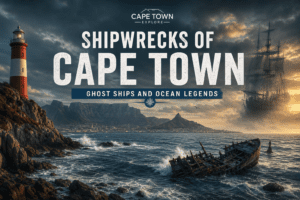
Shipwrecks of Cape Town — Ghost Ships and Ocean Legends
Cape Town is known worldwide for its breathtaking scenery, iconic mountains, and dramatic oceans. Yet beneath the beauty of the coastline lies a deeper story — one shaped by storms, lost ships, and centuries of maritime mystery.
For hundreds of years, sailors rounding the southern tip of Africa faced one of the most dangerous sea passages on Earth. The meeting point of powerful Atlantic currents, unpredictable weather systems, and rugged coastlines turned Cape Town into one of history’s most infamous shipwreck regions.
Today, these stories live on through legends, historic wreck sites, and ghost ship tales that continue to fascinate travellers and historians alike.
The Cape of Storms
Long before it became known as the Cape of Good Hope, early Portuguese explorers called it the Cape of Storms — a name earned through violent winds and towering waves that tested even the strongest vessels.
Before the opening of the Suez Canal in 1869, ships travelling between Europe and Asia had no choice but to navigate around southern Africa. Thousands of trading vessels, naval ships, and explorers passed Cape Town, and not all completed the journey.
Hidden reefs, sudden fog banks, and powerful ocean currents caused hundreds of shipwrecks along the coastline, leaving behind stories that still echo through maritime history.
The Great Shipping Lanes of Cape Town
Cape Town’s maritime importance comes from its position along one of the world’s most historic global shipping routes.
From the 1500s onward, European trading powers established sea routes connecting:
- Europe
- India
- Southeast Asia
- The Far East
- Southern Africa
Ships belonging to the Dutch East India Company, British fleets, Portuguese explorers, and later global merchant vessels all followed the same path — rounding the southern tip of Africa before crossing the Indian Ocean.
Cape Town became a vital replenishment station where ships stopped for:
- Fresh water and food supplies
- Repairs after Atlantic storms
- Crew recovery during long voyages
- Trade exchanges between continents
The route was essential for global commerce, transporting spices, textiles, gold, and later industrial goods between continents.
However, this heavy traffic came at a cost.
Strong crosswinds, dangerous currents, and navigational limitations meant vessels often sailed dangerously close to shore. Winter storms pushed ships toward rocky coastlines, leading to countless wrecks that helped shape the maritime legends of the Cape.
Even today, modern shipping traffic still passes Cape Town, making it one of the busiest maritime corridors connecting the Atlantic and Indian Oceans.
The Legend of the Flying Dutchman
No maritime mystery is more closely tied to Cape Town than the legend of the Flying Dutchman.
According to seafaring lore, a Dutch captain attempted to round the Cape during a violent storm and swore he would succeed even if it meant sailing forever. The ship was said to be cursed, condemned to roam the oceans endlessly.
Sailors reported sightings of glowing sails appearing in storm clouds — an omen believed to warn of danger at sea.
Whether myth or superstition, the Flying Dutchman remains one of the world’s most enduring ghost ship legends and firmly anchors Cape Town within global maritime folklore.
Famous Shipwrecks Along the Cape Coast
SS Thomas T. Tucker
During World War II, this American cargo ship mysteriously ran aground near Cape Point despite modern navigation systems. Crew members believed they were safely offshore, making the wreck one of the Cape’s enduring maritime puzzles.
The Arniston Tragedy
One of South Africa’s most tragic shipwrecks occurred when HMS Arniston sank in 1815 after navigation instruments failed during heavy seas. The disaster influenced improvements in maritime navigation worldwide.
Hidden Wrecks of the Peninsula
Walks along Cape Town’s rugged shoreline still reveal remnants of ships claimed by the Atlantic — rusted hulls and scattered remains silently telling stories of survival and loss.
A Coastline Connected to South Africa’s Maritime Mysteries
Cape Town’s maritime history forms only the beginning of South Africa’s ocean story. The same global shipping lanes continued eastward, where vessels travelled along the Indian Ocean coastline toward KwaZulu-Natal.
These routes contributed to mysterious shipwreck stories and ghost ship legends that became part of South Coast folklore.
Explore the continuation of these maritime mysteries here:
Experiencing Maritime History in Cape Town Today
Visitors can still connect with the city’s nautical past through several iconic locations.
Cape Point Nature Reserve
Towering cliffs and dramatic ocean views reveal why sailors once feared these waters.
Simon’s Town
Historic naval heritage and harbour stories provide insight into Cape Town’s long relationship with the sea.
Shipwreck Viewing Trails
Coastal hikes along the peninsula showcase remains of vessels lost to the Atlantic, blending natural beauty with living history.
Why Maritime Mysteries Still Captivate Us
Shipwreck stories endure because they combine adventure, danger, and the unknown. They remind us that oceans once represented the edge of the world — unpredictable, powerful, and filled with mystery.
Standing along Cape Town’s shoreline today, watching waves roll in from the horizon, it is easy to imagine the ships that once sailed these waters and the legends they left behind.
From the stormy Atlantic around Cape Town to the mysterious Indian Ocean shores of KwaZulu-Natal, South Africa’s coastline continues to tell stories shaped by the sea.
Cape Town Explore
Discover stories beyond the scenery — where history, mystery, and ocean adventure meet.