Discover One of the World’s Great Creative Cities
Cape Town is famous for its mountains, beaches, vineyards and spectacular coastline, but look beyond its natural beauty and you’ll discover another side of the Mother City. Cape Town is also a city filled with art, where contemporary African creativity, historic collections, independent galleries, monumental sculptures, architecture and colourful street art form part of the experience of exploring the city.
What makes Cape Town particularly interesting for art lovers is the relationship between creativity and place. Art isn’t confined to museums or traditional gallery walls. It appears beside the ocean, beneath mountains, within historic neighbourhoods, inside transformed industrial buildings and across the walls of the city. You can plan an entire day around Cape Town’s galleries, or you can discover something remarkable simply by walking through one of its neighbourhoods.
One of the most striking examples we have encountered while exploring Cape Town stands in Camps Bay, beneath the dramatic peaks of the Twelve Apostles.
Exceptional: An Extraordinary Face in Camps Bay
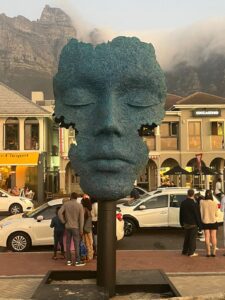
Our main photograph was taken in Camps Bay and captures a remarkable meeting of contemporary art and the Cape Town landscape. Standing prominently within the Camps Bay streetscape is Exceptional, a monumental sculpture by renowned South African sculptor Marco Olivier.
The enormous face immediately commands attention through its scale, form and heavily textured surface, but the setting is what makes encountering the sculpture particularly memorable. Behind Exceptional, the Twelve Apostles rise dramatically above Camps Bay, while the Atlantic Ocean and famous beachfront are nearby. Restaurants, pedestrians, traffic and the everyday energy of one of Cape Town’s best-known neighbourhoods surround the artwork, turning the entire scene into part of the experience.
Marco Olivier is a South African sculptor known for figurative works, including distinctive representations of the human face and large-scale sculptural installations. Exceptional demonstrates how a piece of contemporary South African art can become even more powerful when viewed within the landscape around it.
It is also a perfect introduction to exploring the artistic side of Cape Town. You don’t necessarily need to enter a museum to begin discovering art here. Sometimes it appears unexpectedly while you are exploring the city, and once you start looking, there is much more to discover.
5 Art Galleries and Destinations to Discover in Cape Town
Cape Town has an extensive gallery and museum scene, so narrowing it down to five destinations isn’t easy. Rather than trying to list every gallery in the city, these five provide visitors with a varied introduction to Cape Town’s creative landscape, ranging from contemporary African art and South African heritage to sculpture gardens, architecture and internationally connected contemporary galleries.
1. Zeitz Museum of Contemporary Art Africa – V&A Waterfront
Few Cape Town art destinations make an architectural statement quite like the Zeitz Museum of Contemporary Art Africa (Zeitz MOCAA). Located in the Silo District at the V&A Waterfront, the museum occupies Cape Town’s historic Grain Silo complex, which has been dramatically transformed into a major contemporary cultural institution.
Zeitz MOCAA focuses on contemporary art from Africa and its diaspora, with exhibitions and programmes encompassing a wide variety of contemporary artistic practices. The building itself is an important part of the experience, with the original concrete grain-silo tubes incorporated into the design and carved away to create an extraordinary central atrium and interconnected exhibition spaces.
For visitors wanting to experience contemporary African creativity in Cape Town, Zeitz MOCAA is an excellent place to begin. Its location also makes it easy to incorporate into a larger day at the V&A Waterfront, where art can be combined with architecture, harbour views, restaurants, shopping and other cultural attractions.
Where: Silo District, V&A Waterfront
2. Iziko South African National Gallery – Company’s Garden
For a broader journey through South African art, head into central Cape Town and the historic Company’s Garden, where you’ll find the Iziko South African National Gallery. Its collections encompass historic and contemporary works from South Africa, elsewhere in Africa and internationally, across forms that include painting, sculpture, photography, textiles and works on paper.
The gallery’s location adds considerably to the experience. Stepping outside places visitors in one of Cape Town’s most significant historic and cultural precincts, surrounded by gardens, museums, monuments and architecture. This makes it possible to combine a visit to the National Gallery with a wider exploration of Cape Town’s cultural history rather than treating it as an isolated attraction.
For travellers who enjoy discovering a destination on foot, the Company’s Garden and surrounding city centre provide an excellent opportunity to experience the connections between art, history, architecture and public space.
Where: Government Avenue, Company’s Garden
3. Norval Foundation – Steenberg
The Norval Foundation offers a very different way to experience art in Cape Town. Located alongside the Steenberg wetlands, it brings together modern and contemporary African art, architecture, indigenous gardens and outdoor sculpture within a setting that encourages visitors to spend time exploring rather than simply moving from one exhibition room to another.
Its sculpture garden is particularly important to the experience, allowing large-scale works to be viewed outdoors and in relationship with the surrounding landscape. Moving between the purpose-built galleries and exterior spaces creates a connection between art and nature that feels particularly appropriate in a city where the natural environment is such an important part of its identity.
For travellers interested in sculpture, contemporary African art or architecture, Norval Foundation provides an experience that extends well beyond the conventional gallery format.
Where: 4 Steenberg Road, Tokai
4. Stevenson – Woodstock
Cape Town’s creative landscape extends well beyond its major museums, and independent commercial galleries play an important role in presenting artists from South Africa, across the African continent and internationally. Stevenson is one of the established names within this contemporary gallery scene and has developed an international exhibition programme since its founding in 2003.
Its Cape Town space is situated in the Buchanan Building on Sir Lowry Road, placing visitors within the wider creative landscape associated with Woodstock and its surrounding areas. This part of Cape Town has become known for its mixture of galleries, studios, design businesses, architecture and street art, making a gallery visit an opportunity to explore the neighbourhood more broadly.
Stevenson is therefore particularly relevant for visitors who want to experience contemporary art beyond Cape Town’s major museums and see how the city’s gallery culture connects with its creative neighbourhoods.
Where: Buchanan Building, 160 Sir Lowry Road
5. Everard Read / CIRCA – V&A Waterfront
Everard Read brings another dimension to a Cape Town art itinerary, particularly for visitors interested in South African contemporary art and sculpture. The gallery has a long history within the South African art world, having been established in Johannesburg in 1913, while its Cape Town presence at the V&A Waterfront dates from 1996.
Together with CIRCA, the Cape Town destination offers visitors multiple exhibition spaces and sculpture within the Waterfront environment. Its location makes it particularly easy to combine with Zeitz MOCAA, allowing visitors to create a broader art-focused itinerary through the precinct rather than visiting a single museum.
This concentration of different art experiences is one of the strengths of the Waterfront. Within the same part of Cape Town, visitors can encounter major contemporary African exhibitions, commercial galleries, sculpture, architecture and the historic harbour landscape.
Where: Portswood Road, V&A Waterfront
Cape Town’s Art Scene Goes Far Beyond Five Galleries
These five destinations are only an introduction to Cape Town’s much larger creative landscape. The city is also home to galleries and spaces such as AVA Gallery, Goodman Gallery, WHATIFTHEWORLD, blank projects, Barnard Gallery and SMAC Gallery, alongside smaller independent galleries, studios and temporary exhibition spaces.
This variety is part of what makes exploring art in Cape Town so rewarding. There isn’t a single Cape Town art experience that every visitor needs to follow. One day might be spent inside a major museum, while another could involve moving between independent galleries and creative neighbourhoods. On another day, the most memorable artwork might be something discovered unexpectedly while travelling between attractions.
For art lovers, that means Cape Town can be explored repeatedly without the experience feeling the same. Exhibitions change, new artists emerge, galleries evolve and the creative character of different neighbourhoods continues to develop.
Cape Town’s Streets Are Part of the Art Experience
Some of Cape Town’s most memorable art experiences happen outside formal galleries. Murals, sculptures, monuments and public installations extend creativity into the city’s streets and public spaces, while areas such as Woodstock and Salt River have become particularly associated with colourful murals and street art.
These works turn walls, buildings and streets into canvases and provide another way of experiencing Cape Town’s creative culture. Instead of deliberately visiting an exhibition, travellers can encounter art as part of exploring a neighbourhood, visiting a restaurant or simply moving through the city.
Marco Olivier’s Exceptional in Camps Bay is an excellent example of this experience. You might arrive in Camps Bay intending to visit the beach, enjoy lunch or admire the Twelve Apostles, only to find yourself standing in front of an enormous contemporary sculpture. That sense of discovery is an important part of what makes Cape Town interesting as an art destination.
Explore Cape Town Through Art
One of the best ways to experience Cape Town’s art scene is to use art as a reason to explore different parts of the city. Each neighbourhood offers a different combination of galleries, architecture, history, landscape and public creativity.
In Camps Bay, the famous beach, Atlantic views and Twelve Apostles provide the setting for public works such as Marco Olivier’s Exceptional. At the V&A Waterfront, visitors can combine Zeitz MOCAA with Everard Read and CIRCA while exploring the Silo District, harbour and surrounding architecture.
The Company’s Garden and Cape Town city centre offer another experience entirely, combining the Iziko South African National Gallery with historic buildings, monuments, museums and some of the city’s most important cultural sites. Woodstock provides an opportunity to discover contemporary galleries such as Stevenson while exploring a neighbourhood associated with studios, design and street art.
Further south, Steenberg offers the Norval Foundation, where contemporary art, sculpture, architecture, indigenous gardens and the surrounding landscape come together. Rather than simply working through a checklist of galleries, travelling between these areas allows visitors to experience Cape Town itself.
Where Art and Landscape Meet
There are many cities around the world with extraordinary museums and galleries, but Cape Town’s artistic character is closely connected to its setting. A contemporary art museum occupies a transformed grain silo overlooking the harbour, sculptures stand within gardens and wetlands, galleries occupy historic and former industrial buildings, and murals transform ordinary city walls into large-scale artworks.
Then there is Exceptional. Beneath the Twelve Apostles in Camps Bay, a monumental sculpted face sits within one of Cape Town’s most recognisable landscapes. The mountains, architecture, streets and people surrounding the sculpture become part of the scene, demonstrating how naturally art can become integrated into the experience of the city.
It is this relationship between art, architecture, landscape and everyday city life that gives Cape Town’s creative scene its distinctive character. Visitors don’t have to choose between exploring the destination and exploring its art; the two experiences can become part of the same journey.
Discover One of Cape Town’s Most Creative Sides
Cape Town’s mountains, beaches and coastline may be what first capture your attention, but they are only part of the story. The city’s museums, galleries, sculpture gardens, murals, architecture and public artworks reveal another side of Cape Town that is worth making time to discover.
Our photograph of Marco Olivier’s Exceptional captures what inspired this guide. It wasn’t photographed inside a museum or discovered during a planned gallery visit. It was encountered while exploring Camps Bay, with the Twelve Apostles providing an extraordinary backdrop.
That is perhaps one of the best ways to approach art in Cape Town. Visit the museums and galleries, but also explore the neighbourhoods, pay attention to the architecture, look for murals and take notice of the sculptures you pass along the way. In a city with such a rich relationship between creativity and place, remarkable art can appear where you least expect it.
Cape Town Among the World’s Great Cities for Art
Around the world, certain cities have become destinations in their own right for art lovers. Paris is celebrated for its great collections and centuries of European art, while London combines historic institutions with contemporary galleries. New York brings together world-famous museums and a constantly evolving contemporary scene, while Berlin is known for experimental art, independent galleries and street culture.
Elsewhere, Barcelona combines art with extraordinary architecture, while Rome surrounds visitors with sculpture, architecture and artworks spanning centuries. Tokyo brings traditional Japanese creativity together with contemporary art, design and digital experiences, while Mexico City is renowned for its museums, murals, architecture and artistic heritage. Melbourne has developed its own reputation for galleries and street art woven into the city’s famous laneways.
Cape Town belongs naturally in this wider conversation, but its artistic experience is distinctly its own. Here, contemporary African art, South African history, sculpture, architecture and street creativity exist within an extraordinary natural landscape. Visitors can explore contemporary African art inside a transformed grain silo, discover sculpture within indigenous gardens, encounter murals across creative neighbourhoods and unexpectedly find monumental works such as Marco Olivier’s Exceptional beneath the Twelve Apostles.
It is this combination of art, African creativity and landscape that gives Cape Town its distinctive place among the world’s great creative cities.
Cape Town’s landscapes may first capture your attention, but its art gives you another reason to keep exploring.